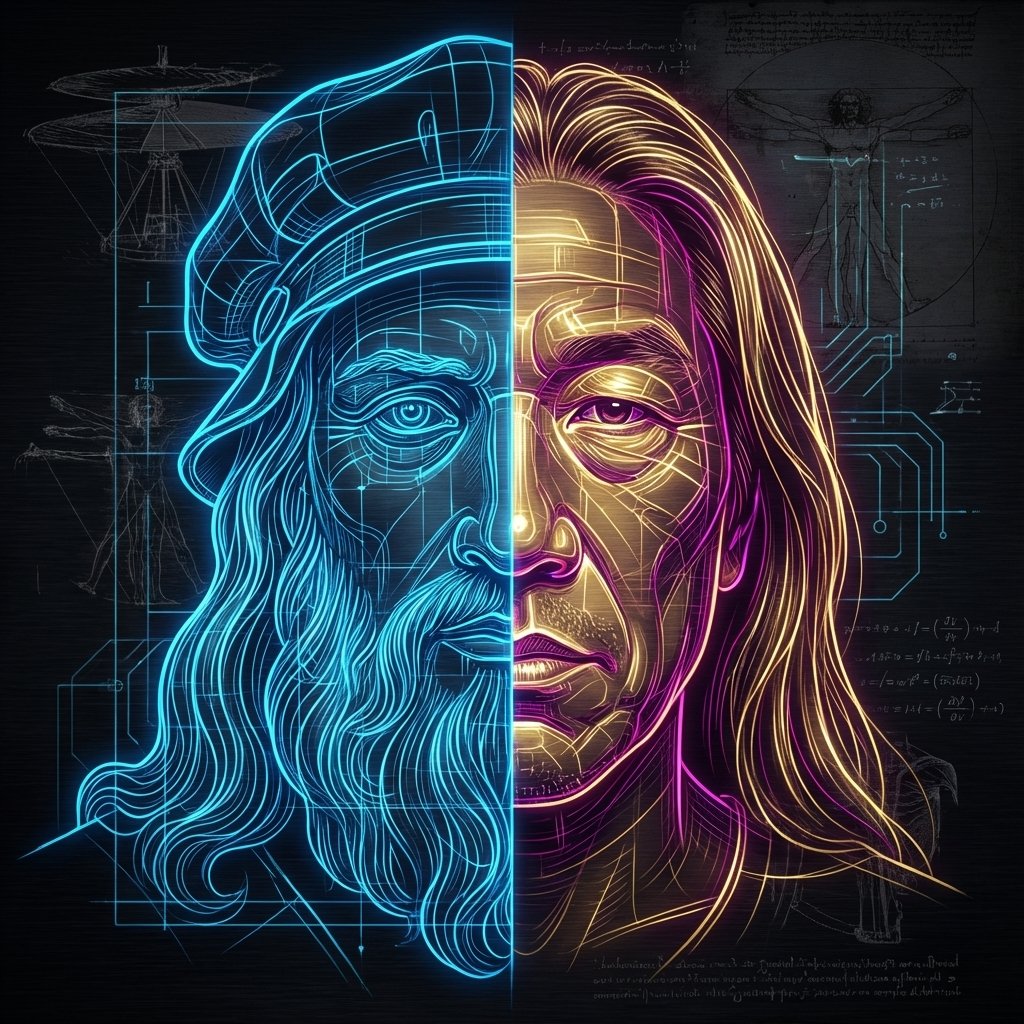
Leonardo da Vinci is often cited as the ultimate "Renaissance Man," but his path to brilliance was born of necessity and exclusion. Because he was born out of wedlock—a "bastard" in the eyes of 15th-century law—he was barred from traditional higher education and the prestigious guilds of his father’s status. This social rejection forced him to become entirely self-taught. Instead of learning through Latin textbooks, he developed a rigorous method of "learning by doing" and "learning by seeing." He treated the entire world as his laboratory, filling thousands of notebook pages with microscopic observations of water flow, bird flight, and light, essentially inventing a personal version of the scientific method long before it was formalized.
To support his lifestyle and curiosity, Leonardo often marketed himself not as a painter, but as a military engineer. He spent years in the service of powerful patrons like Ludovico Sforza and Cesare Borgia, designing terrifying war machines—including armored tanks, giant crossbows, and even scythed chariots. While many of these remained sketches, they funded his deeper explorations into nature and the human form. His notebooks were filled with designs for flying machines and mechanical wonders that were hundreds of years ahead of their time. For centuries, these designs were dismissed as mere fantasies because they couldn't be built with the primitive materials and lack of internal combustion engines available in the 1400s. However, modern science has vindicated him; recently, researchers at the University of Liverpool in the UK constructed a glider based on his "ornithopter" sketches and proved that the concept was aerodynamically sound and capable of flight.
Perhaps his most tragic contribution lies in the field of medicine. Leonardo performed clandestine dissections on over 30 human corpses, producing anatomical drawings so accurate they wouldn't be rivaled for 600 years. He was the first to describe the four chambers of the heart and the intricacies of the vascular system. Because his notebooks went missing or were hidden for centuries after his death, his discoveries had no impact on the medical progress of his era. Had his work been published during his lifetime, it is estimated that medical science might have advanced by 200 to 300 years, potentially saving millions of lives throughout the Enlightenment. Leonardo remains the ultimate proof that a curious, self-taught mind, unburdened by the rigid dogmas of formal schooling, can become one of the greatest intellectual forces in human history.
Stay tuned for an upcoming video of some kind on the genius of Leonardo Da Vinci